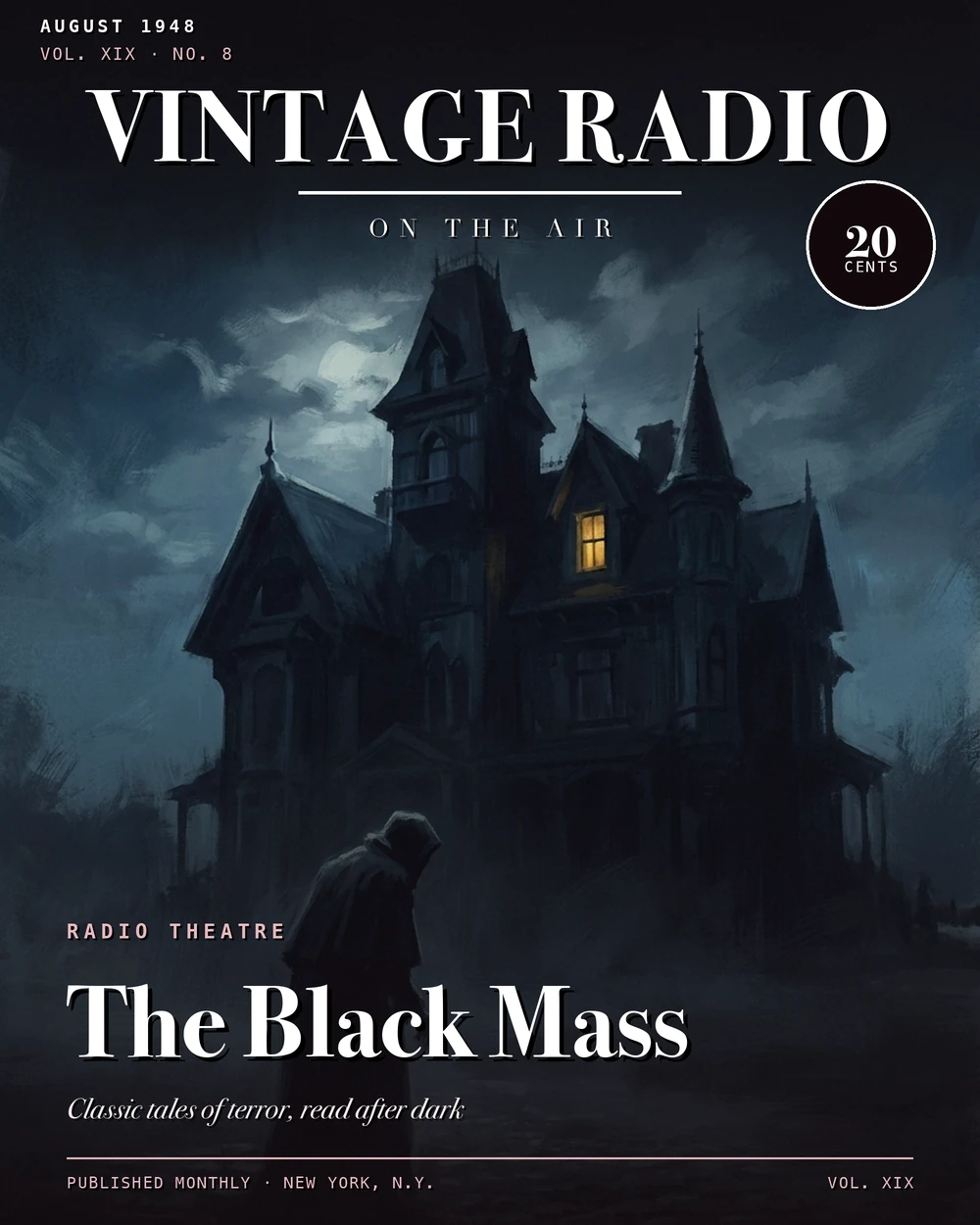
The Black Mass
The Show That Shouldn't Have Existed
By the early 1960s, dramatic radio in America had largely surrendered to television. Network budgets had dried up, and the ambitious audio drama of earlier decades was mostly a memory. Into that vacuum came The Black Mass — a late-night horror anthology produced not by a major commercial network, but by KPFA in Berkeley, a listener-supported station operating under the Pacifica Radio umbrella. KPFA was, in fact, the first listener-supported radio station in the United States, which meant it answered to its audience rather than to advertisers. That freedom shaped everything about what The Black Mass became.
The series ran on KPFA and KPFK in Los Angeles from 1963 to 1967 on an irregular schedule, airing at 11:30 PM and wrapping near midnight. It adapted classic horror and dark literary fiction — H.P. Lovecraft, Edgar Allan Poe, Franz Kafka, Ambrose Bierce, Henry James, Virginia Woolf, M.R. James, Bram Stoker, Herman Melville, Gogol, Fyodor Dostoyevsky, Walter de la Mare, and Lord Dunsany, among others. This was not crime-detective programming in the commercial radio sense. It was something more literary and more unsettling: a late-night encounter with the dark edges of the written word, produced by people who cared deeply about both literature and sound.
Erik Bauersfeld and the Pacifica Experiment
The driving force behind The Black Mass was Erik Bauersfeld, born in Brooklyn on June 28, 1922. Bauersfeld came to KPFA in 1961 and eventually served as Director of the Drama and Literature Department for 31 years — a remarkable tenure that reflected both his dedication and the station's unusual institutional character. The concept for the series was originally suggested to him by Jack Nessel, the Drama and Literature Director at KPFA, who encouraged Bauersfeld to develop something specifically for the late-night slot.
Bauersfeld's collaborator on most episodes was John Whiting, KPFA's production director. Whiting did double duty as sound designer and dramaturge, meaning he helped select the literary works that the series would adapt. It was Whiting who designed the series' opening format — an ominous storyteller persona that drew consciously on the tradition of early radio horror, including The Witch's Tale. The format kept the narrator dominant, with character voices drifting in and out, while music and sound effects built atmosphere behind the reading. There were no host introductions or formal credits on the series' recordings; the storytelling simply began, and the listener was pulled in.
A Ph.D. dissertation later credited the Bauersfeld–Whiting collaboration with "keeping radio drama alive in America in the 1960s." That's a striking claim, but the context makes it understandable. This was the post-television era, and commercial radio drama had essentially ceased. What Bauersfeld and Whiting were doing at KPFA was, in a very real sense, one of the few places in the country where serious audio theater was still being made.
How It Sounded
Producing The Black Mass was not easy, and the technical constraints the team worked under are part of the story. Bauersfeld and Whiting did not have access to multitrack recording equipment — standard by that point in the music industry, but apparently out of reach for a listener-supported public radio station in Berkeley. As a result, music and sound effects had to be added painstakingly to voice tracks, often in sessions that ran late into the night.
Music for the series came from several Bay Area composers, including Charles Shere, KPFA's Music Director, who was also a working composer and music critic. The atmospheric sound design was built carefully around each episode's source material, with the goal of creating tension and dread through audio alone — no visuals to fall back on, no studio audience to cue the mood. The series was designed to be heard in the dark, near midnight, and the production decisions reflected that.
The first episode, "All Hallows," adapted a Walter de la Mare story about a haunted cathedral, which set the tone for what followed. Confirmed episode sources include M.R. James's "The Ash Tree," Lovecraft's "The Rats in the Walls" and "The Outsider," Virginia Woolf's "Haunted House," Ambrose Bierce's "Oil of Dog," Kafka's "A Country Doctor," Poe's "The Man in the Crowd" and "MS Found in a Bottle," and Henry James's "The Jolly Corner." Other surviving titles — "Moonlit Road," "The Death of Halpin Fraser," "The Squaw" — suggest the range of dark literary territory the series covered.
A Complicated Survival
The episode count for The Black Mass is genuinely uncertain, and the numbers vary depending on where you look. Broadcast logs list 31 episodes. The Bay Area Radio Drama archive lists 38 radio tales from 1963 to 1970. At least 43 episode plotlines are documented in fan research databases. The catalog in circulation today contains 18 episodes. What can be said with confidence is that the series was produced irregularly over several years, and not everything that was broadcast has been accounted for.
Two of the Lovecraft adaptations — "The Rats in the Walls" and "The Outsider" — received a limited LP release in the 1970s, with a pressing of approximately 1,000 copies. The Pacifica Radio Archives hold a recorded broadcast of "The Rats in the Walls," performed by Bauersfeld and Bernard Mayes, with technical production by Whiting, dated July 13, 1964. These are the kinds of breadcrumbs that survive from productions made outside the commercial system, without the institutional infrastructure that preserved so many network-era shows.
In 1986, Bauersfeld founded the Bay Area Radio Drama (BARD), a nonprofit organization dedicated to promoting audio theater. Many Black Mass episodes were later made available through the BARD archive, which extended the series' reach considerably beyond its original Bay Area audience.
What It Left Behind
Critics who have written about The Black Mass tend to compare it with celebrated late-night horror series like Quiet Please, Hall of Fantasy, Mysterious Traveler, The Whistler, Lights Out, and Suspense. Those comparisons put the series in serious company. Most of those shows were network productions with commercial sponsors and professional casts drawn from the radio establishment. The Black Mass was something more homegrown — produced at a public radio station, assembled largely at night, without the benefit of modern studio equipment, by people who were committed to literature and to sound.
The series had a documented influence on later audio drama. Writer-producer Thomas Lopez of ZBS — a production company that created its own innovative audio drama in subsequent decades — identified Bauersfeld as his mentor and credited The Black Mass as an acknowledged influence on his work.
Bauersfeld himself went on to a very different kind of fame. In 1983, he provided the voice of Admiral Ackbar — as well as Bib Fortuna — in Return of the Jedi, and he reprised the Ackbar role in Star Wars: The Force Awakens in 2015. He died on April 3, 2016, at the age of 93. The Black Mass recordings represent a distinct and earlier chapter of his career, one that sits apart from his later celebrity but reflects the same willingness to commit to a project fully and on its own terms.
The Black Mass aired at the very end of the era when radio drama was a living form in the United States — not at the height of it, but in its late, fragile twilight. The fact that it was made at all, and made with the seriousness that it was, is itself worth paying attention to.